
'The robust tax collections give the finance minister a fair amount of headroom for an expansionary fiscal policy.'

The Centre has, perhaps for the first time, decided to provide funding support to farmer-producer organisations, krishi vigyan kendras, custom hiring centres, and individuals for purchasing them.

India and China have mostly set aside their bilateral differences in order to champion the cause of developing countries at the World Trade Organisation (WTO). That seems to be changing. During the latest round of China's trade policy review, India questioned its northern neighbour's claim that it was a developing country, since, going by the World Bank's definition, its per capita income belongs to that of an upper middle income country. "As per the per capita income level, the Chinese economy belongs to 'upper-middle income'. "How can China still claim to be a developing country? "What are the indicators which China is using to claim such a status?" India asked.

Deciding the goods and services tax rate on fryums papad could be a messy affair with the Appellate Authority for Advance Rulings (AAAR) of Gujarat now ruling that the ready-to-eat product would draw 18 per cent rate. In that connection, it slightly modified the ruling of the state-based Authority for Advance Rulings (AAR). The AAR had also ordered that these products would draw 18 per cent GST but under a different classification.

'How low GDP would have been, we don't know.' 'It raises serious questions because so many indicators are pointing to such a sharp decline and GDP estimates are still showing 4 per cent growth.'

The government's food subsidy in the ongoing fiscal year is expected to be a little less than Rs 4 trillion.

'There will always be a challenge to maintain a fine balance to ensure that the growth keeps happening and inflation is contained.'

'The classic thing we need as a country is the virtuous cycle where you have robust demand which leads to more capital spending which in turn leads to more job creation and more money in the hands of people.'

After the government sought Parliament's nod for a second batch of supplementary demand for grants that will cause a hit of Rs 2.99 trillion to the exchequer, doubts suddenly arose about the government's ability to meet the Budget projections of reining in its fiscal deficit at 6.8 per cent of gross domestic product (GDP), or Rs 15.06 trillion, for the current financial year. Till now, many were of the opinion that the government would succeed in checking the deficit at a much lower figure than what was given in the Budget Estimates (BE). The government had sought Parliament's approval to spend Rs 3.74 trillion extra, but Rs 74,517.01 crore will be matched by equal savings on other heads.

Come January and the government is empowered to send its recovery officials to your premises to collect GST without notice, if your tax liability shown in the requisite form is less than what invoices, mentioned in the outward supply form, should draw. The relevant provision in the Finance Act, 2021, will come into effect from January 1, 2022, according to a gazette notification issued on Tuesday. Under the GST system, there are two kinds of returns that a company is required to file monthly if its turnover is over Rs 5 crore annually. These are form GSTR-1 and GSTR-3B.

'It is far too early to celebrate the numbers.' 'They are still fairly weak compared to the pre-pandemic level.'
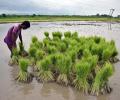
Among the key demands of agitating farmers has been a legal guarantee on minimum support price (MSP). The protest reached a crescendo when thousands of farmers from Punjab and elsewhere marched towards Delhi late last year and decided to block the main entry points once they were denied entry. The Centre, on its part, held 11 rounds of discussions with the protesters and even offered to amend some of the provisions without much success. With now one of their chief demands met, farmers have now moved on to force the government to concede on MSP.
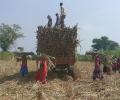
Nitin Tyagi is a young farmer in Budhagaon village of Baghpat district of Uttar Pradesh. A few years ago, Tyagi left his fairly lucrative job in the medical industry and shifted base to his ancestral village to look after his land and property. He opened a small shop selling farm inputs in the village and also started taking a greater interest in agricultural matters which had so far been looked after by his father and uncles. Tyagi and his brothers primarily grow sugarcane, potato and wheat on nearly 10 acres of land with sugarcane taking up most of his time and effort. Being one of the most important and lucrative cash crops of the region, sugarcane is directly linked to the fate of millions of farmers in west UP and with it, the electoral fortunes of political parties seeking their votes in the coming assembly polls.

'While we note the very strong cyclical recovery in the economy, we believe there is still uncertainty over medium-term prospects.'
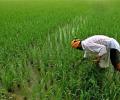
Gross value added in agriculture and allied activities clocked a healthy growth rate of 4.5 per cent at constant prices in the second quarter of FY22, up from 3 per cent during the same period last fiscal year and 3.5 per cent in Q2 of 2019-20. In the first quarter of FY22, gross value added in the sector was also 4.5 per cent. Growth in current prices was also a healthy 7.9 per cent in July-September 2021-22, up from 7.3 per cent in the same quarter last fiscal year. It was slightly less than the 8.7 per cent of the second quarter of 2019-20.

The Centre, after the repeal of the farm Acts, may bring in another important piece of legislation concerning farmers in the form of the long-pending Seeds Bill. This will be in the ogoing winter session of Parliament. Sources said the draft Seeds Bill, in the way it was prepared in 2019, sought to overcome several of the shortcomings of the Seeds Bill of 2004, which was proposed to replace the Seeds Act of 1966. However, the 2004 Bill could not be cleared owing to deficiencies in it.

'We need to encourage the next generation of farmers to continue in farming'

'As far as contract farming is concerned, we already have a model Act and states will be encouraged to adopt them.'

New Delhi and Washington have agreed to count the benefits of a global agreement on taxation from the next financial year. However, the benefits would actually accrue once the global pact comes into effect or March 31, 2024, whichever is earlier, in the form of credit.

The country needs 100 million jobs in the formal sector in the next decade to take advantage of its demographic dividend. Also, it should get into the global supply chain to generate many of those by negotiating trade deals effectively, industry players and experts have said. "We need something like 100 million jobs in the next 10 years, which means that the non-agriculture sector has to generate 14 per cent job growth every year," said Aditya Ghosh, co-founder of Akasa Airlines, at the Global Economic Policy Summit organised by the CII.
 © 2025 Rediff.com - Investor Information - Advertise with us - Disclaimer - Privacy Policy - Sitemap - Feedback - About us - Terms of use - Grievances